It’s still normal for direct selling brands to run their commission engine and customer storefront on a single platform. The setup looks clean on paper. It’s either all in-house or it’s in one contract, one vendor, with less external integrations.
The reality hits hard on a Friday afternoon when your marketing team wants to change a hero banner, adjust retail pricing on three SKUs, or run a forty-eight-hour flash sale. That’s when progress stops.
Two Systems with Opposing Jobs
Forcing one piece of software to manage financial compliance and retail marketing creates a technical compromise:
- The Commission Engine as a Financial Ledger: This system must remain rigid, secure, and exact, locking down historical transaction records, enforcing binary legs or unilevel downline volumes, and applying compression rules where a tiny rounding error triggers calls from furious field leaders.
- The Storefront as a Conversion Engine: Modern storefronts demand speed, fast testing, dynamic product grids, and one-tap checkout through Shop Pay because shoppers bounce immediately if a page stalls.
The True Cost of Dependency Drag
Tying the retail frontend directly to the back-office ledger creates continuous bottlenecks:
- Every design tweak risks core back-office payout calculations.
- Every database lock slows down customer checkout speeds.
- Marketing teams wait three weeks for a developer to deploy basic banner changes.
- Engineering teams treat routine seasonal promotions like dangerous code releases.
How Prüvit Broke the Cycle
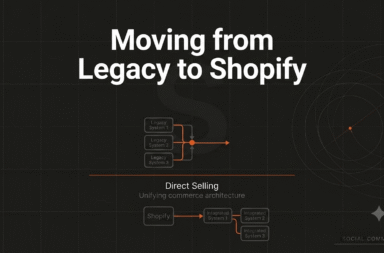
Prüvit eliminated that bottleneck by separating its retail store from its commission and back-office software:
- Removed developer tickets for marketing campaigns across 41 countries, 7 languages, and 6 currencies.
- Allowed marketing staff to publish landing pages without touching custom code.
- Shifted internal planning from asking whether a campaign could be built to asking how fast it could launch.
Separation of Concerns in Practice
Decoupled architecture lets each component focus on its primary strength:
- The Back Office: Calculates distributor genealogy, volume totals, rank rules, and payout accuracy.
- The Front End: Drives buyer acquisition, browsing speed, and checkout conversion in your direct selling ecommerce setup.
- The API Bridge: Connects both environments without compromising data security on either side.
All systems play to their strengths and do what they do best.
Software vendors serving this channel should support this shift. Decoupled architecture does not threaten their position in direct selling commerce; it frees them from maintaining retail front ends they were never equipped to build for ecommerce for direct sales.
To audit your platform across your direct selling operations, contact ShopIQ.com today.