Auto-delivery and subscription programs form the bedrock of customer retention across direct sales. A customer enrolled in a recurring order buys predictably, stabilizes monthly revenue, and generates consistent volume without demanding continuous sales calls from the field distributor. Direct selling leadership understands the cash flow economics.
The technical side of that cycle receives far less executive attention. Direct selling subscriptions must execute on rigid calendar schedules: charge stored cards, record warehouse shipments, log customer history, and trigger downstream volume to the correct distributor leg across every single monthly cycle.
The process tolerates zero operational failure. A card declines without automated retry rules, and the customer lapses immediately. A database strips the sponsor token on month four, and the distributor loses an earned residual payout. Field complaints mount quickly.
Four structural breakdowns ruin subscription performance in direct selling ecommerce:
1. Broken Recurring Attribution
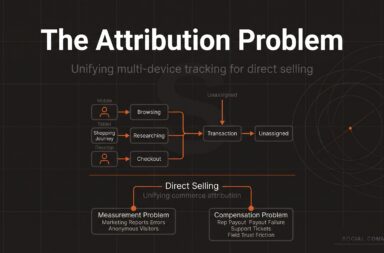
The distributor who enrolls a subscriber earns the commission on every renewal, not just the initial signup cart. Tracking breaks down quietly.
Third-party checkout plugins and basic shopping carts routinely record renewal orders as anonymous recurring system events. The corporate bank account collects the cash; the commission engine records zero distributor volume. The distributor watches their residual paycheck drop each month, assumes corporate greed, and stops working the business.
2. Subscriptions and Commissions Disconnect
When your direct selling subscriptions manager runs separately from your commission ledger without direct synchronization, renewal calculations stall. Engineering teams end up building brittle cron jobs to sync databases.
Commissions calculate late, trigger incorrect rank qualifications, or skip volume entirely. Operations managers spend the first week of every month manually editing spreadsheets to reconcile payment processor transaction IDs with distributor accounts. Operations burns payroll hours fixing data rather than expanding business lines.
3. Direct Selling Subscription Swaps and Schedule Errors
Subscribers want total control: pausing a shipment, skipping a month, adjusting delivery dates, or swapping protein flavors. Every cart modification must update back-office point values in real time.
Basic retail tools handle an item swap easily, but they fail to recalculate corresponding Commissionable Volume (CV) or Business Volume (BV) attached to the new product SKU. The customer receives the new flavor, while the compensation engine calculates downline bonuses based on an item cancelled two weeks ago. The resulting discrepancy creates support tickets that tie up accounting teams for days.
4. Primitive Payment Recovery and Dunning Logic
Expired credit cards, bank fraud alerts, and billing address mismatches happen on every recurring cycle. Basic retry scripts fail.
Without smart retry schedules, automated account updater integrations, and immediate customer recovery notifications, expired cards silently wipe out 5% to 10% of your recurring customer base every quarter. A subscription program lacking modern recovery logic leaks cash every thirty days in direct selling commerce.
Subscription programs remain the primary driver of customer lifetime value in ecommerce for direct sales. Convert that potential into durable enterprise cash flow by testing the technical foundation supporting every renewal.